Is Studying Abroad Still Worth It? An Honest Accounting
Studying abroad is still worth it in 2026, but for a narrower band of students than the industry admits — those choosing destination and course by employment maths rather than by dream.
By Mandeep Singh · Published 4 August 2026

The honest answer, up front
Studying abroad is still worth it in 2026, but for a narrower band of students than the industry admits: those choosing destination and course by employment maths rather than by dream, with financing that survives a one-year salary delay, and files clean enough to clear record-high visa scrutiny. For that student, the return remains excellent. For the marginal applicant, the honest answer has genuinely changed.
An industry that earns commission on enrolments will always answer "yes" to this question. We'd rather keep our answer honest, because students who go abroad on bad maths come back with debt, and they remember who advised them. So here is the accounting as we'd do it for our own children, with this year's numbers.
What changed, plainly
The case for going abroad used to survive sloppy planning. Three shifts ended that.
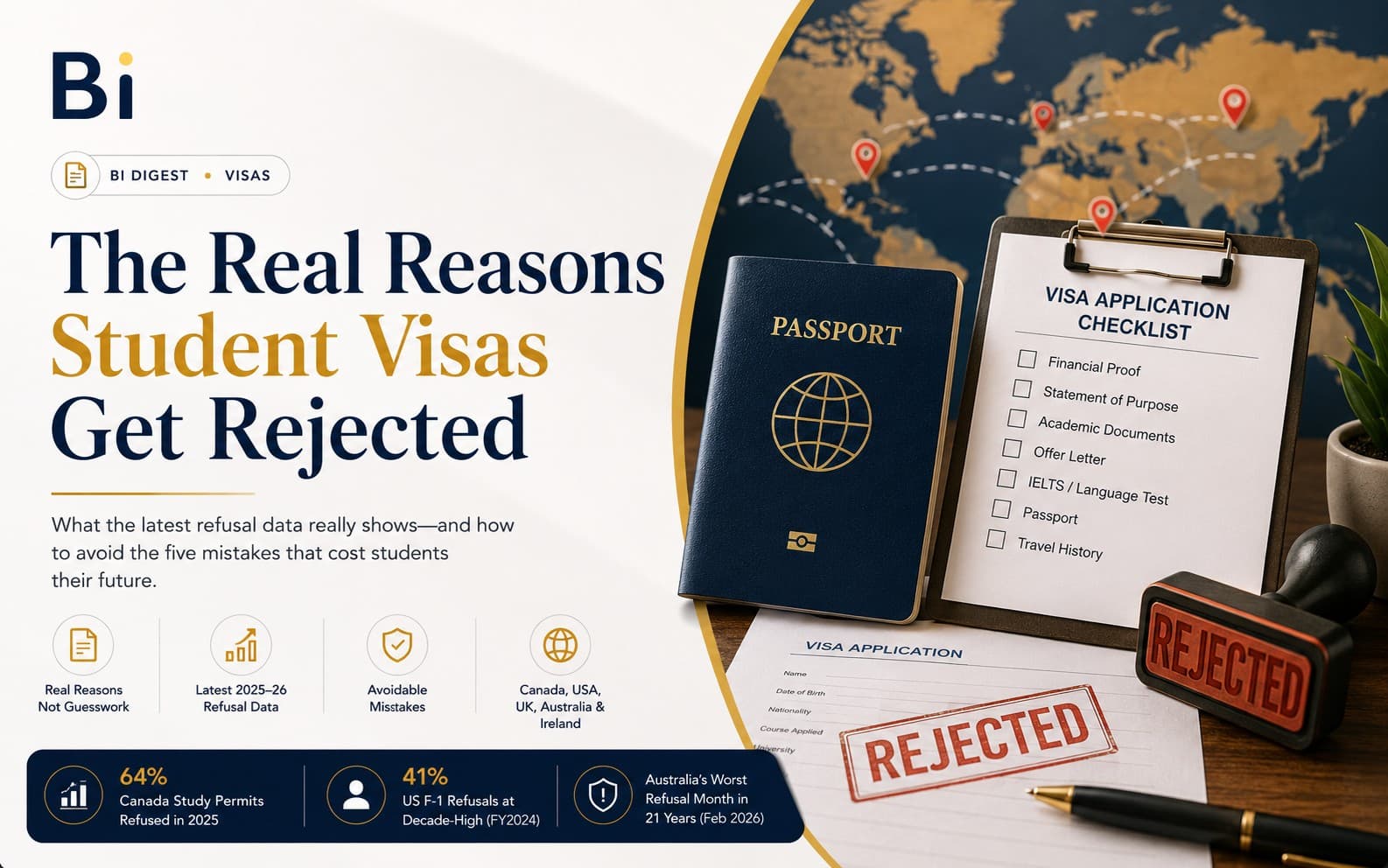
Visas became the hard step. Canada's study-permit refusals peaked around 65% in early 2025, and IRCC data reported by Reuters showed 74% of Indian applications refused in August 2025, against 32% two years earlier. The US hit a decade-high 41% F-1 refusal rate in FY2024, per State Department data. Australia recorded its worst refusal month in 21 years in February 2026 (32.5% of university applicants refused, 40% for India), and moved India into its highest-scrutiny documentation tier in January 2026. A visa refusal now costs real money (Australia's fee alone is AUD $2,000, non-refundable), a permanent mark on your file, and often a missed intake. The reasons are knowable and mostly avoidable, but "I'll get the visa" is no longer a safe background assumption. It's the central risk of the whole project.
Post-study runways shortened. The UK's Graduate Route drops to 18 months for 2027 applicants. Canada has been tightening PGWP eligibility. Australia trimmed its post-study visa lengths. The window between graduating and needing an employer to sponsor you has compressed nearly everywhere, which means the job-market strength of your specific course in your specific city matters far more than it did five years ago.
Costs rose faster than salaries at home fell behind. UK maintenance requirements jumped to £13,761 for London. Total costs for a UK or US master's now regularly cross ₹40–60 lakh. Meanwhile, salaries for good graduates in India's own tech and finance sectors have kept climbing, which raises the bar an overseas degree has to clear to beat the domestic alternative.
None of this makes going abroad a bad decision. It makes it a decision, with numbers, instead of a default aspiration.
The maths that actually decides it
Strip the question to its skeleton: total cost abroad, versus what the degree realistically earns you, versus what you'd have earned and spent staying home. Three variables dominate the outcome, and none of them is university ranking.
The course-to-job pipeline. A computer science or data master's feeding into Dublin tech, a nursing qualification feeding into the UK's staffing shortage, an engineering degree feeding into Germany's industrial base: these have visible, hiring-now pipelines, and the degree pays for itself in two to four years of local salary. A generic business master's at a mid-tier university with no placement record has no pipeline, and the same tuition money buys mostly an expensive stamp. The single best predictor of "worth it" is whether you can name, before applying, the specific jobs the course feeds and see people actually getting hired into them.
Whether you can hold the post-study window. The degree's return mostly gets collected during the post-study work visa: local salary, local experience, and a shot at sponsorship. A student who must return home immediately after graduating collects only the brand value, which for most non-elite universities is modest. So the compressed runways change the calculus directly: 18 months is enough time to convert if the course sits in a hiring sector and the job hunt starts before graduation. It is not enough time to figure things out from scratch.
The financing structure. The same degree is worth it funded by family capital or a clean education loan with manageable EMIs, and not worth it funded by high-interest borrowing that assumes a best-case foreign salary from month one. The stress test is simple: if it took you nine months to find a job, and that job paid the 25th-percentile salary for your field, does the plan survive? If yes, the risk is priced. If no, you're not investing, you're gambling with interest.
Run those three honestly and the destination question mostly answers itself, which is why we treat "where" as downstream of "why": Ireland vs Germany vs UK is a different comparison for a coder than for a commerce graduate.
Who it's still clearly worth it for
The pattern across our files is consistent. It's worth it for the student in a globally traded skill (software, data, healthcare, specific engineering) heading to a destination whose job market is actually short of that skill. It's worth it when the family finances survive the stress test above without heroic assumptions. It's worth it for the student who wants to work abroad, not just study abroad, and picks course and city accordingly. And it's worth it for the genuinely academically excellent, for whom scholarships and elite-university brands change the maths entirely.
Who should honestly wait, or stay
It's not worth it, this year, for the student assembling a file to beat a visa system rather than to pursue a career: 2026's refusal rates are precisely designed to catch that file, and the cost of a refusal follows you. It's rarely worth it for the generic master's with no pipeline, funded by maximum-stress borrowing, chosen because peers are going. And "wait" is a legitimate answer we give more often than you'd expect: a year spent raising grades, seasoning finances, or gaining work experience frequently converts a marginal file into a strong one, and a probable refusal into a probable approval. The intake calendar comes around every year. A refusal stays on the record permanently.
Our honest position
BNPS has been placing students abroad since 1954, through every previous version of "is it still worth it": post-Brexit panic, pandemic closures, every visa tightening cycle. The pattern each time is the same: the marginal, poorly planned applications wash out, the well-built ones keep succeeding, and the students who did the maths look back on the decision as the best one they made. Our 98.2% visa success rate in a record-refusal year isn't evidence that the system is easy. It's evidence that the system still rewards files built properly, which has always been the real answer to this question.
Worth it? For the right student, with the right course, on honest numbers: emphatically, still, yes. The change is that "the right student" is now something you have to actually be, not just claim.
Frequently Asked Questions
Is studying abroad still worth it in 2026?
Yes, for students in employable fields with a clear course-to-job pipeline, financing that survives a slow job search, and clean visa files. The returns remain strong for that profile. For generic degrees funded by high-stress borrowing, the maths has genuinely worsened.
What has changed about studying abroad recently?
Three things: record visa refusals (Canada's peaked ~65% in early 2025 with 74% for Indian applicants by August; US F-1 at a decade-high 41%), shortened post-study work visas (UK dropping to 18 months for 2027 applicants), and costs rising while home-country salaries improve — raising the bar a foreign degree must clear.
Which degrees abroad have the best return on investment?
Degrees feeding visible hiring shortages: software and data roles, healthcare and nursing, and specific engineering fields. The predictor is whether you can name the jobs the course feeds into before applying.
Is it better to wait a year before applying to study abroad?
Often, yes. A year spent improving grades, seasoning finances, or gaining work experience can turn a probable refusal into a probable approval — and intakes recur every year, while a visa refusal stays on your record.
Sources
Canada study-permit refusals peaked ~65% in early 2025 (from 38% in 2023)
GradPilot analysis of IRCC open data ↗74% of Indian study-permit applications refused in Aug 2025 vs 32% in Aug 2023; overall ~40% that month
IRCC data via Reuters / Deccan Herald ↗81% Indian refusal figure (Dec 2024)
IRCC Visa Integrity report, via Careers360 ↗US F-1 refusals at 41% in FY2024, a 10-year high (278,553 refused)
State Dept data analysed by Cato Institute, via VisaVerge ↗Australia: 32.5% university-applicant refusals Feb 2026, worst in 21 years; India ~40%, Nepal 65%, Bangladesh 51%
ICEF Monitor (Home Affairs data) ↗India placed in Australia's highest-risk evidence tier, Jan 2026
Business Standard (Rajya Sabha statement) ↗Australia student visa fee AUD $2,000, non-refundable
Dept of Home Affairs visa pricing ↗UK Graduate Route shortening to 18 months; UK maintenance £13,761 (London)
GOV.UK Graduate visa ↗Figures and rules change; always confirm against the official source for your application date.
Have a question this didn't answer?
Every situation is different. Talk to a counsellor for advice specific to your profile, budget, and timeline.